i
I am interested in the border between one person and another — and in how stable that border really is.
Not as an idea I arrived at intellectually, but as something I once experienced with a clarity that was difficult to forget: the sense that the boundary between myself, other people and the world around me was much less solid than it usually appears. I still don't know if that moment revealed something about reality, or simply changed the way I perceive it. But it left me with a question I keep returning to: What changes when we stop seeing ourselves as separate?
My work is, in different ways, an attempt to explore that question.
Music came first. As a kid, I was the one carrying a Walkman around school, stopping people to play them something I had just discovered. At fifteen, a friend taught me how to DJ with vinyls. Years later, listening was no longer enough and I began producing my own music.
What still fascinates me is music's ability to bypass explanation. A sound can return you to a place you haven't thought about in years. It can create an emotion that wasn't there a second earlier. For a few minutes on a dancefloor, a room full of strangers can move as if it were one organism.
Painting has a different history for me. My grandfather was a watercolor painter, and as a child I would sit and watch him work for hours. As a teenager, I found my own way into painting through graffiti — outside, at night — until getting caught brought that chapter to an abrupt end. I didn't paint again for years.
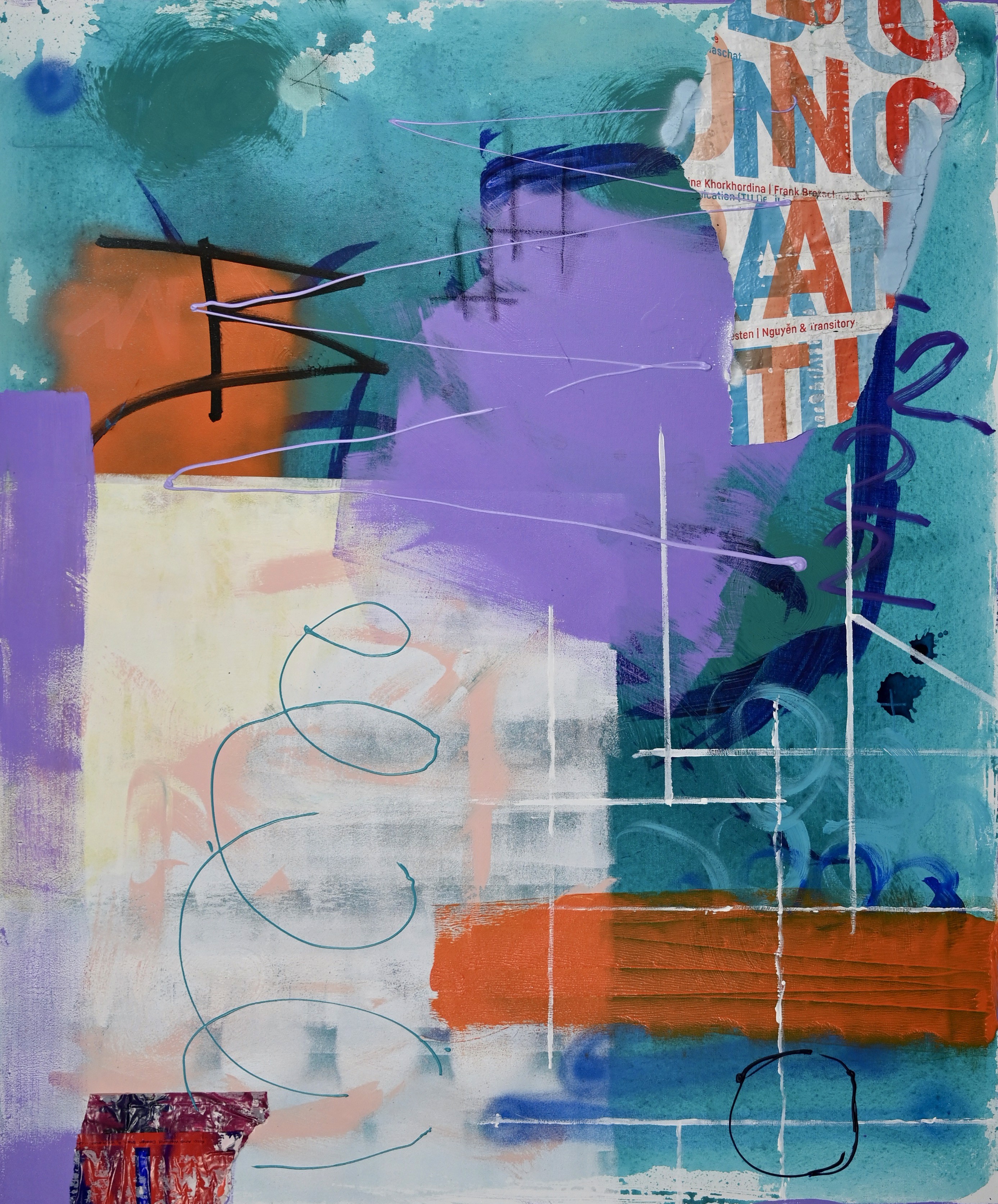
At twenty-seven, I returned to it. This time on canvas, with acrylic, oil stick, spray paint, pencil and whatever else could leave a trace. Rather than illustrating unity, I use these to destabilize the boundaries we take for granted: bodies merge with landscapes, personal histories become collective ones, scientific fragments collide with symbols, language and intuition. The canvas becomes a place where different systems of meaning can exist at once, without fully resolving into an answer.
Painting gives me something music cannot, and music gives me something painting cannot. A painting holds a space. A track unfolds through time. I move constantly between the two.
When I paint, music is almost always playing. Sometimes I leave the canvas to work on a track and return hours later seeing the painting differently. One medium interrupts the habits of the other. And somewhere between sound, colour, movement, words and intuition, things appear that I could not have planned beforehand.
I think of it as designing space and designing time.
What connects both is my interest in the invisible things that move between people: memory, fear, tenderness, identity, belonging, separation — and the strange fact that we experience ourselves as separate beings while remaining entangled, in every material sense, with everything around us. Difference is real. The question is whether separation is.
I am less interested in giving answers than in creating situations where that question can become uncertain for a moment.
A dancefloor can do that.
A painting can do that.
A room can do that.
We — Humans, my first solo exhibition, brings these worlds together. Opening September 9, 2026 at Holzmarkt in Berlin, it combines painting, sound and space around one simple proposition: perhaps separation is something we have learned to see.
The work doesn't ask anyone to believe that.
It asks what might happen if, for a moment, we looked again.
design
W Hoodie
black, back print — available at the show
W Cap
black, embroidered — available at the show
space


B222
time
